
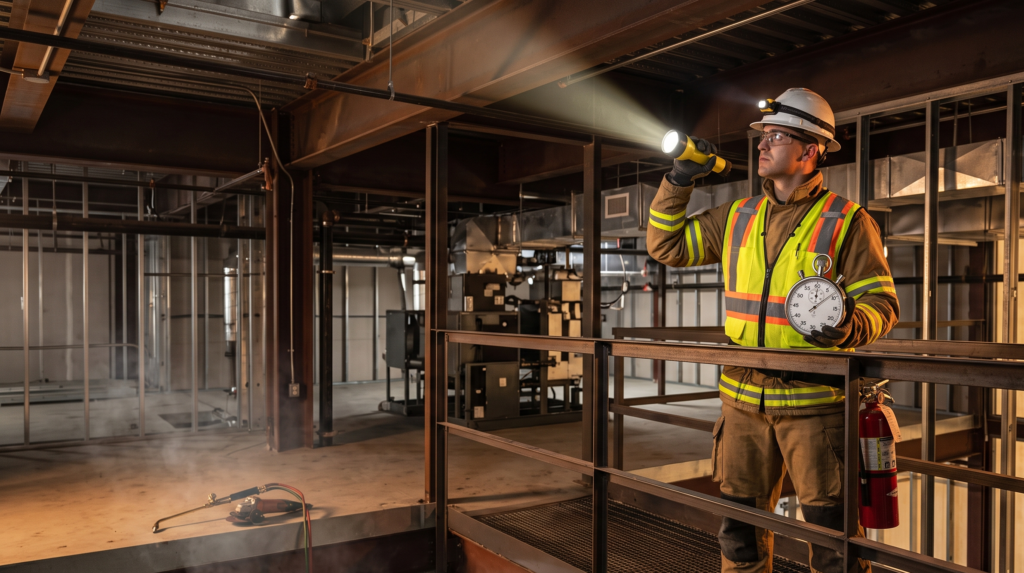
Hot work fire watch requirements start with a number that changed. Under NFPA 51B, 2019 edition and later, the watch continues for at least 60 minutes after the work stops. OSHA sets a floor of 30 minutes.
Both numbers are correct. Which one applies to your jobsite depends on what your authority having jurisdiction adopted.
The second half of the requirement gets missed far more often. The watch covers adjacent spaces, including the space directly above the work.
Two numbers, two rulebooks
OSHA 1910.252(a)(2)(iii)(B) requires the fire watch to be maintained for at least 30 minutes after hot work is complete. That is the general industry rule. Construction falls under 1926.352.
NFPA 51B Section 5.6.1.1 sets 60 minutes. The 2019 edition doubled the older 30-minute period, and later editions retained it.
Where a local fire code adopts NFPA 51B, the 60-minute figure governs. That is common in commercial construction.
The standard also lets the Permit Authorizing Individual extend post-work monitoring beyond the hour. NFPA 51B allows an extension up to three additional hours when the hazard assessment calls for it.
Confirm the number with your fire code official before the torch comes out. The same principle applies to when a fire watch is required for a system outage, where the local edition also decides the details.
The 35-foot survey
NFPA 51B Section 5.2 requires a survey of the area within 35 feet of the hot work location before anything is lit.
Inside that radius:
- Combustible materials get removed or covered with fire-resistant material.
- Floor and wall openings get covered, so sparks cannot drop or travel behind.
- Gaps, conduit penetrations, and air ducts get sealed against spark migration.
- A portable fire extinguisher goes at the hot work location, immediately available.
One item on that list gets violated by contractors more than the rest. Sprinkler heads in the immediate area must never be covered or blocked to protect them from spatter.
A covered head during hot work disables the one system designed for this hazard.
The spaces crews forget
Sparks and heat travel. They move through wall openings, conduit penetrations, and floor and ceiling assemblies.
NFPA 51B requires adjacent spaces to be checked as part of the patrol. That includes the space directly above the work and any space reachable through an opening.
In practice, four places get skipped: the far side of the wall being welded, the floor below, the ceiling plenum, and the chase behind the penetration.
A watch that walks only the room where the grinder was used has covered a fraction of the hazard.
The clock resets
The 60-minute period begins when hot work stops. Document that time.
If work resumes during the monitoring window, the clock restarts from the new stop time. A tool change or a move to a second joint resets it.
Crews treat the hour as one block, added on once the shift finishes. The standard calls for a block after every stop.
Who authorizes the work
The Permit Authorizing Individual, or PAI, signs the hot work permit.
That person conducts or approves the pre-work survey, designates and briefs the fire watch, and sets how long post-work monitoring continues. Nobody lights anything until those conditions are confirmed.
A written permit is required whenever hot work happens outside a designated area. A designated area is a permanent location arranged and equipped for safe hot work, such as a welding shop.
The watch has one job
The person on hot work fire watch is trained in the use of extinguishing equipment. That person also has the authority to stop work when conditions turn unsafe.
Their assignment is fire prevention. Not production, not material handling, not a second post.
The policy on suppression should be stated before work begins: put out what an extinguisher can handle, and otherwise sound the alarm and evacuate.
Every duty period, patrol, and structure entered goes in the record. The fire watch log is the proof.
Before the next welding day
Post the permit, brief the watch, and set the clock at each stop. Book coverage for the monitoring window rather than the work window, since the two are different lengths.
Metro One Security provides construction fire watch across Wayne, Oakland, Macomb, and Washtenaw counties, with trained personnel and documented rounds. Call (248) 436-4799 or request a quote.
Confirm your post-work monitoring period with your local fire code official, since the adopted edition decides the number.